


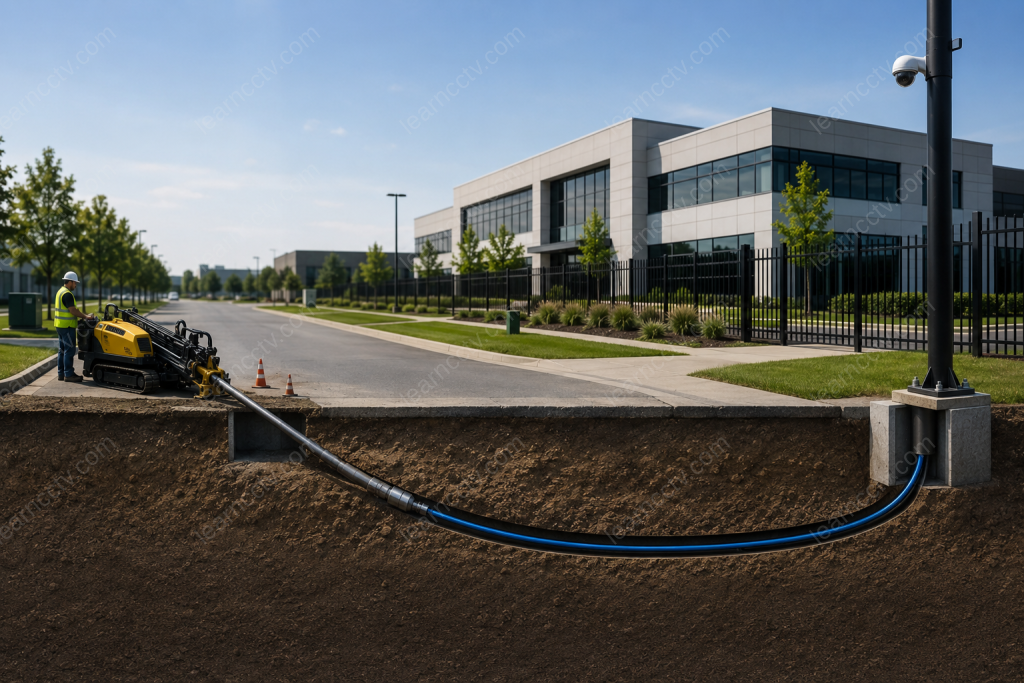
A CCTV expansion can look like a low-voltage job. On an active U.S. property, it often becomes a civil job first. The cable route may cross asphalt, sidewalks, truck lanes, landscaped areas, public right-of-way, private utilities, storm drains, or unknown owner-installed lines. If the team treats the work as a simple camera upgrade, the bore crew discovers the risk in the field. That is the expensive point to discover it.
Directional drilling helps when the owner needs new camera backbone without open cuts across paved or busy surfaces. It does not remove the hard parts. The owner still has to control 811 tickets, private locates, potholing, permits, traffic control, drill-fluid risk, pull tension, closure quality, and restoration obligations. The project succeeds when design and field work protect three things at the same time: the existing utilities, the surface above the bore, and the future serviceability of the CCTV network.
This article turns the research into a practical decision framework for U.S. security, facilities, construction, and IT teams. It focuses on how to choose the trenchless method, how to protect fiber and coax runs, and how to avoid a low-disruption plan that turns into a utility strike or pavement repair dispute.
Executive takeaway
For most U.S. CCTV backbone projects that must cross paved areas, driveways, sidewalks, campuses, or road rights-of-way, horizontal directional drilling should be evaluated first. It gives the crew a steerable path and can place conduit or microduct under surfaces that the owner wants to keep open. Pneumatic piercing can beat HDD on short, straight, well-verified crossings. Pipe ramming fits casing-heavy or difficult ground. Microtrenching can move fast only where the local authority allows it and where the owner accepts shallow-plant maintenance risk.
The best default backbone is fiber in HDPE conduit or bundled microduct. Direct-buried fiber works, but it weakens future repair and replacement options. Coax still fits short legacy drops and special video/RF paths, but it is a poor long-term backbone choice for distributed modern camera systems.
Why CCTV cable routes need civil planning
A camera location is visible. The cable route is not. That is why CCTV projects fail in the underground layer. The team may know where cameras should go, but not where power, gas, fiber, irrigation, lighting control, storm lines, abandoned conduit, or private campus lines sit below the route.
HDD reduces surface disruption, but it increases the cost of bad assumptions. A wrong locate, a missed private utility, or a shallow municipal microduct can turn a small bore into a strike, shutdown, or redesign. OSHA rules require the employer to determine the estimated location of underground installations before excavation, contact the utilities within local response times, and determine exact locations by safe and acceptable means when work approaches the marked utility. Hydro-vacuum excavation can satisfy that verification role when crews use it in a way that does not damage the utility.
That sequence matters for CCTV because many routes start on private property and then cross public space. A camera pole at a gate may look like a private security task, but the conduit may pass under sidewalk, curb, street, DOT frontage, or a railroad approach. Each ground owner can add its own permit and depth rules.

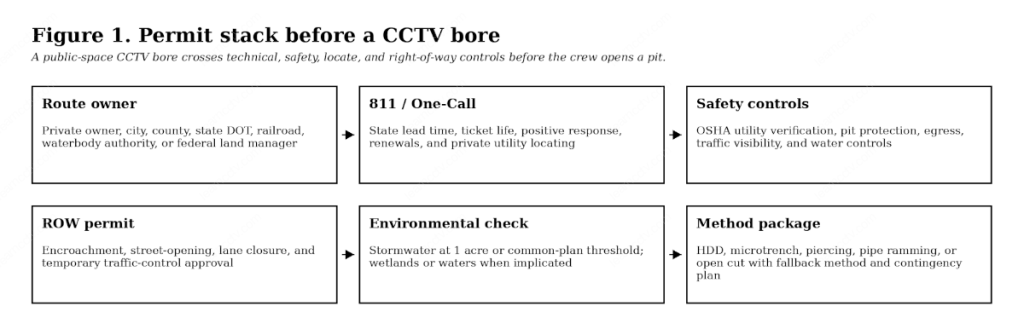
Figure 1. Permit stack before a CCTV bore. The controlling authority is the owner of the ground being crossed, not the camera vendor.
Start with the route owner and the 811 clock
The U.S. uses a nationwide 811 / One-Call concept, but each state controls lead time, ticket life, renewal rules, and positive response. A bore that takes one day in the field can still take a week or more to reach a legal and safe start. Permits, lane closures, potholes, and locate renewals must sit on the same schedule.
State examples show the spread. Texas and Florida use two-business-day lead times in the cited examples. New York uses at least two full working days but limits how early the ticket can be placed. Colorado uses a three-business-day lead time and a longer validity window. California projects often treat tickets as a 28-calendar-day window. A multi-camera route can cross several phases, so the owner should track locate validity like a permit condition, not like a reminder.
The 811 ticket does not solve private-line risk. Many campuses, warehouses, hospitals, shopping centers, and industrial parcels contain owner-installed electric, irrigation, lighting, communications, gate-control, and security lines. Public utility members may not mark them. The owner should order private utility locating and potholing where the route crosses legacy site infrastructure or where records look incomplete.
Choose the trenchless method by surface risk and underground certainty
The method choice should start with two questions. First, what surface does the owner need to protect: new asphalt, a truck lane, an ADA sidewalk, a bike lane, landscaping, a rail approach, or a public arterial? Second, how well does the team know the underground conditions? HDD works best when surface sensitivity is high and utility information is strong enough to drill safely.
HDD should not become the automatic answer for every small crossing. A short, straight driveway or sidewalk lateral may fit pneumatic piercing better. A crossing that needs a steel sleeve, or that runs through cobbles and boulders, may need pipe ramming. A dense downtown curbline may fit microtrenching only if the municipality allows it and accepts the restoration detail. Large pipe jacking or microtunneling rarely fits ordinary CCTV, but it can matter in shared utility corridors.
Design the pathway for future service, not only today’s pull
The CCTV system will change. Cameras move. Analytics increase bandwidth. Gate controls add devices. A route that only solves today’s cable pull can become a trap when the owner needs a new fiber count or a repair.
For backbone runs, fiber in HDPE conduit or bundled microduct gives the strongest long-term path. It supports future pull-in or blowing, protects the cable, and lets the owner repair or expand the plant without digging again. Microduct vendors support installation by directional bore, trench, plow, and microtrench, and the cited Dura-Line guidance recommends a 50% to 75% fill ratio for cable placement performance.
Direct-buried fiber can work, and cable manufacturers publish procedures for it. It gives the owner less flexibility. If the cable fails or the camera system needs more capacity, the repair may require another excavation or bore. Coax belongs in a narrower role: short legacy analog drops, special RF/video paths, or existing camera systems that cannot move to IP/fiber yet.

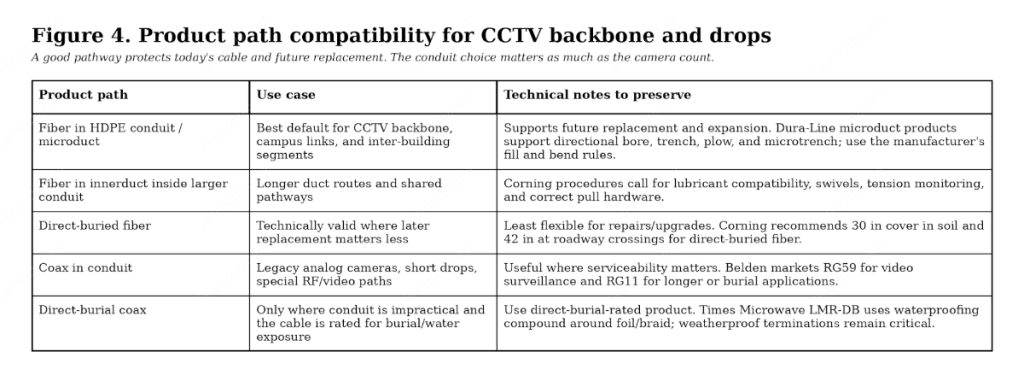
Figure 4. Product path compatibility for CCTV backbone and drops. The pathway decision affects future repairs more than the camera mount does.
Keep the critical numbers visible during design
Depth and clearance are not national constants. The final answer comes from the permit authority, the right-of-way owner, the utility-accommodation manual, and the selected product manufacturer. The research shows why the designer should not assume a single U.S. rule.
Corning recommends 30 inches of cover in soil and 42 inches at roadway crossings for direct-buried fiber. A New York highway right-of-way example uses a desirable minimum cover of 60 inches within roadways and 36 inches outside the roadway. Hillsborough County allows communication lines with 24 inches of cover outside paved roadway surfaces and requires 18 inches of vertical clearance from nearby facilities. Nashville microtrenching requires at least 12 inches depth and 10 inches of cover over microduct. New York City examples allow much shallower microtrenching: 4 inches below sidewalk grade and 6 inches below street grade. These numbers cannot all govern the same project. They show why local verification controls the design.
Route verification is where the project earns its low-disruption claim
A low-disruption bore only stays low-disruption when the crew knows what it is drilling near. The safest route package combines 811, records review, private locating, and potholing. PPI guidance recommends locating buried structures and utilities within 10 feet of the drill path for mini-HDD and 25 feet for maxi-HDD. Crossing lines should be exposed when the route approaches conflict points.
The OSHA safety bulletin on the Kansas City cable-installation incident shows the cost of a wrong assumption. Crews exposed shallow utilities and assumed they had found the gas line. They had not. The drill later hit the gas line, which led to explosion and fire. The lesson applies directly to CCTV work: the pothole must verify the exact utility, not just show that something exists underground.
The owner should also match the locate process to the equipment used in the field. A crew planning HDD or boring under paved surfaces needs route verification equipment and field procedures that support the actual bore path. For utility locating and HDD route verification around security infrastructure, the Digitrak Falcon F5 locator is an example of equipment category that belongs in this planning context, not as a decorative add-on after the route is set.

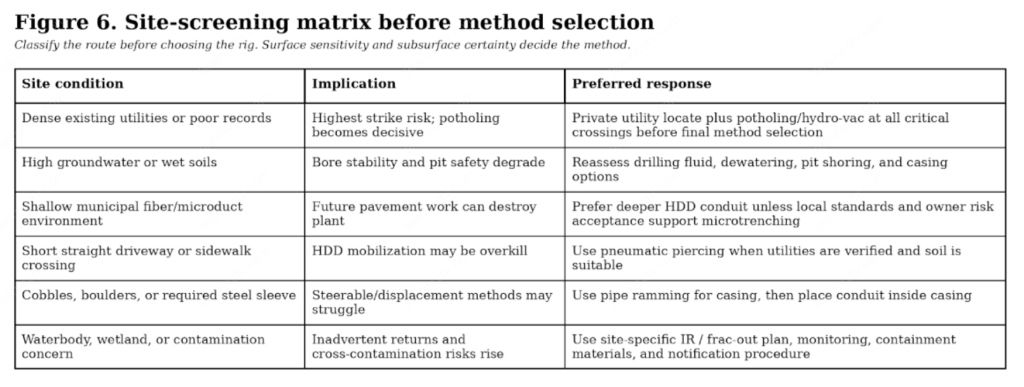
Figure 6. Site-screening matrix before method selection. The matrix prevents the team from choosing a trenchless method before it knows the route risk.
Control the four field risks: strike, frac-out, pull damage, and blocked duct
The main HDD risk is often information quality, not drill power. A CCTV bore can fail through a utility strike, an inadvertent return of drilling fluid, a cable or conduit pull that exceeds safe tension, or a duct that looks installed but cannot accept the cable.
The contingency plan should name the stop points before field work starts. If locate marks conflict or a private line appears, the crew stops and potholes. If pressure or mud returns suggest loss of circulation, the crew slows or stops, inspects the path, protects drains and waters, and follows the inadvertent-return plan. If pull tension rises toward the cable or conduit limit, the crew stops, swabs, reams, or changes the pull strategy. If the installed duct is blocked, the crew rods, mandrels, or cleans it before cable placement. If the local standard creates shallow plant, the owner accepts that risk in writing or chooses a deeper method.
Fiber procedures make these controls specific. Corning calls for a swivel between the pull line and pulling grip, compatible lubricant, tension monitoring except on very short hand pulls, and figure-eight handling to prevent twist and kinking. Its common bend-radius rule structure references loaded and installed radius to cable OD, and its cited procedure states a 600 lbf maximum pulling tension for stranded loose-tube and ribbon designs unless the cable data sheet allows otherwise.
Cost: HDD wins when it avoids restoration, not because every foot is cheaper
The project team should compare methods by total installed cost. Bare linear-foot prices hide the real cost of surface restoration, traffic control, permit duration, and schedule risk.
Recent public bid tabs show wide variation. One 2026 FDOT signalization tab showed open-trench conduit at about $20 to $41 per linear foot and directional-bore conduit at about $41 to $50 per linear foot. Another 2026 FDOT tab showed directional-bore conduit at about $24 to $27 per linear foot. A 2024 Columbus, Georgia CCTV/ITS-type bid tab showed 3-inch to 9-inch directional bores at about $15.20 to $16.20 per linear foot.
The restoration rules can change the answer. Hillsborough County can require asphalt replacement plus centered overlay of 100 feet on roads at 35 mph or less and 200 feet on roads above 35 mph for open trench crossings. Nashville requires milling and paving if a microtrench exceeds width limits, and bike-lane work can add milling, paving, and remarking. A modest HDD premium can disappear when an open cut triggers a larger pavement obligation.
A practical breakeven example
If HDD adds $15 per linear foot over open trench on a 200-foot paved crossing, the installation premium equals $3,000. A broad overlay, lane closure package, striping repair, bike-lane restoration, or night-work restriction can exceed that amount quickly. This does not make HDD automatically cheaper. It shows why the estimate needs separate lines for installation, restoration, traffic control, and permit risk.
Build the work as a gated process
A reliable CCTV bore sequence uses gates. Each gate prevents the field crew from discovering a design problem with the drill running. The owner should not release construction until the route, locate records, private-line risk, potholes, permit conditions, traffic-control plan, product path, and contingency plan all agree.
The construction package should specify the launch and reception pits, pit protection, ladder or egress requirements, traffic devices, dewatering, stormwater controls, drill-fluid containment, conduit proofing, tracer or locatable duct requirements, splice closures, OTDR testing, and closeout data. This level of detail protects both the construction schedule and the future maintenance team.
Materials and equipment checklist
The exact equipment changes by route, but a complete U.S. CCTV trenchless package usually includes white-lining paint, survey or GIS base mapping, electromagnetic locating, GPR where useful, hydro-vac or hand potholing tools, mini-HDD rig, drill head and locating beacon, walkover locator, rods, reamers, mud mixer, pumps, containment, pneumatic piercing tools for short laterals, pipe-ramming gear where casing is needed, HDPE conduit or bundled microduct, tracer wire or locatable duct where the owner requires traceability, pull tape, handholes or vaults, splice closures, fusion splicer, OTDR, labels, and restoration materials.
The owner should also require route documentation that maintenance crews can use later: handhole IDs, closure IDs, conduit size, installed depth notes at critical crossings, splice matrix, fiber test results, restoration photos, and permit sign-off. Without those records, a trenchless installation can become invisible risk.
Maintain the underground layer after turnover
A clean bore does not end the owner’s work. Underground CCTV plant needs inspection at access points and restoration areas. Handholes, splice closures, cabinets, terminations, lids, drainage, and surface settlement create many failures. The conduit path itself often performs better than the places where crews enter it.

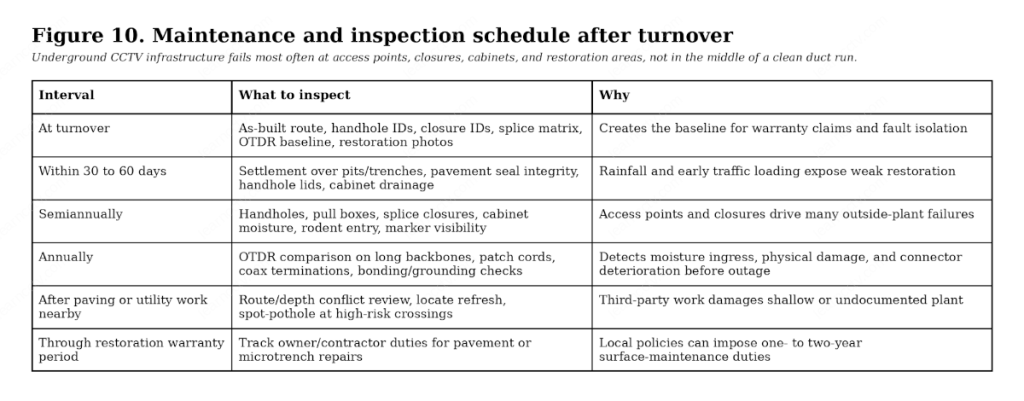
Figure 10. Maintenance and inspection schedule after turnover. The first inspection should happen soon enough to catch settlement and water issues.
Practical bottom line
For a U.S. CCTV program with no state-specific constraint, the most defensible starting design is fiber backbone in HDPE conduit or bundled microduct; HDD for road, driveway, sidewalk, railroad, stream, and congested utility crossings; pneumatic piercing only for short straight well-verified service bores; pipe ramming where soil or crossing authority makes casing prudent; microtrenching only where the municipality clearly allows it and the owner accepts future pavement risk; and coax only for short legacy or special-use drops.
That design does not remove the need for engineering. It gives the owner a safer default. The project still needs local permit verification, exact utility verification, field potholes, pull-in limits, drill-fluid controls, restoration obligations, and maintenance records. When the owner controls those items, directional drilling can add CCTV coverage without turning the property into an open trench project.
Source basis
This article is based on the attached research document and its cited U.S. source set, including OSHA excavation guidance, 811 / One-Call examples, FHWA trenchless and temporary traffic-control materials, PPI HDD guidance, Corning fiber installation procedures, Dura-Line microduct literature, public bid tabs, local ROW and microtrenching policies, and manufacturer materials for HDD, pneumatic piercing, pipe ramming, fiber, coax, and closures.